

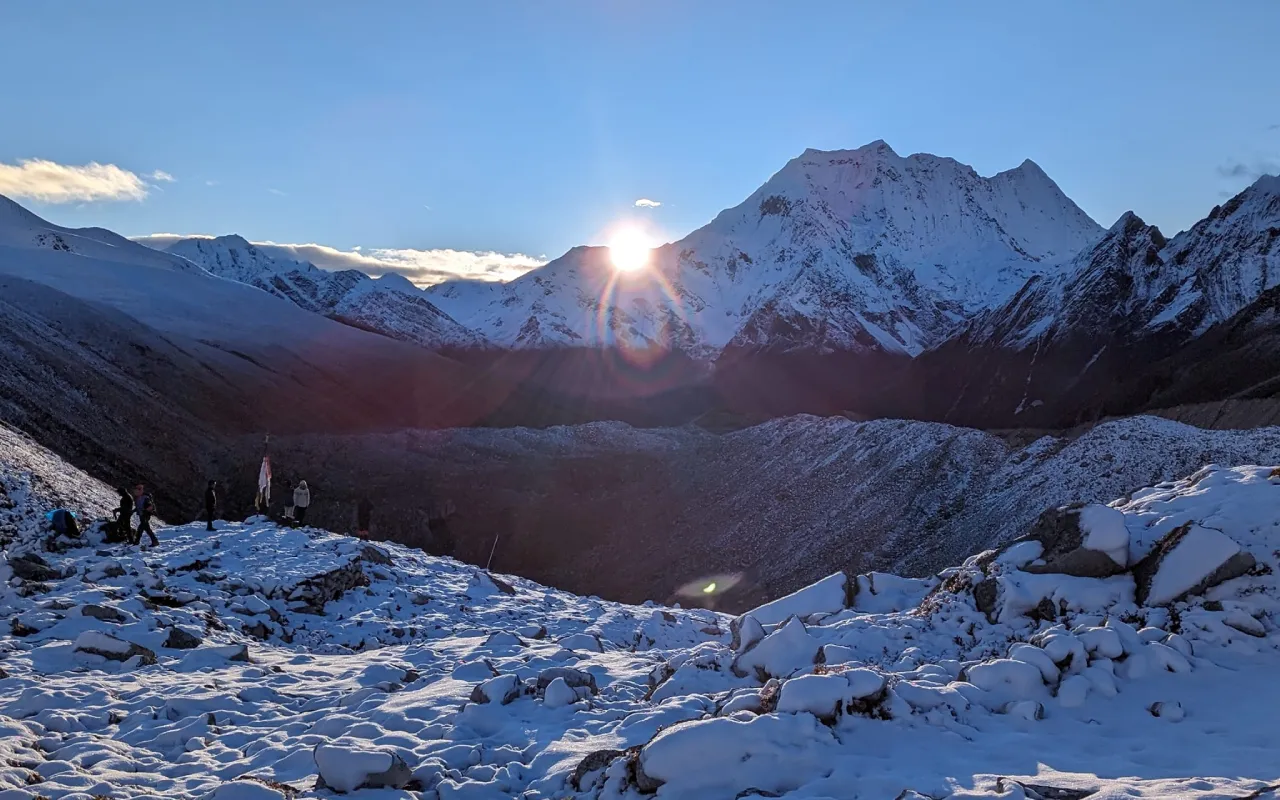
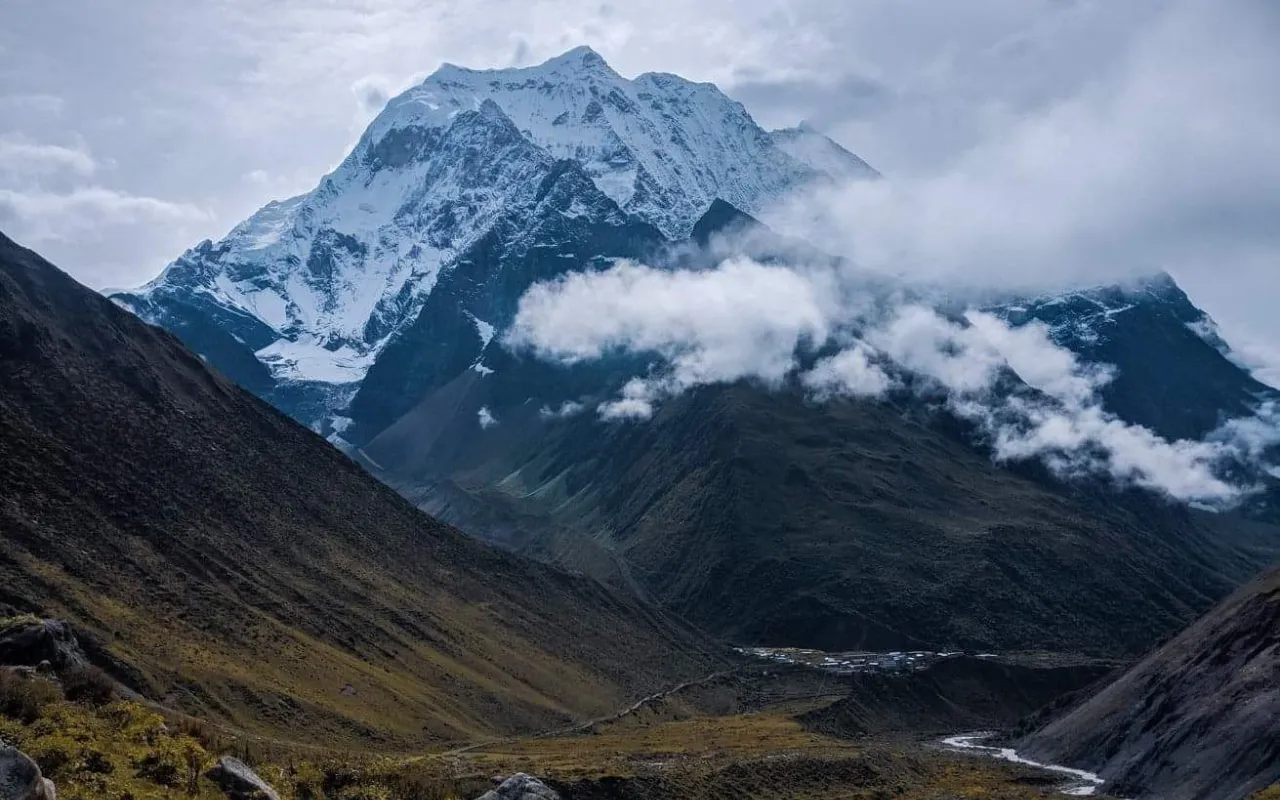

Nepal’s largest national park, in Dolpo behind the Himalaya.
Overview
Shey-Phoksundo covers some 3,555 square kilometres of Dolpa and Mugu, most of it above 3,000 metres and much of it in the trans-Himalayan rain shadow. It is the largest national park in Nepal.
Phoksundo Lake, a deep turquoise at 3,611 metres, is its best-known feature; Shey Gompa, the crystal monastery beyond the Kang La, is its spiritual centre and the subject of Peter Matthiessen’s The Snow Leopard.
The park holds snow leopard, blue sheep, and Bon and Buddhist communities living much as they have for centuries. Access is restricted in Upper Dolpo and needs permits arranged well ahead.
Itinerary
Day 1 :
Arrive in Kathmandu
You are met at the airport and transferred to your hotel. The afternoon briefing is a detailed one, because Dolpo has the slowest permits in Nepal - the Upper Dolpo restricted area permit is issued in limited numbers, must be applied for through a registered agency and takes weeks rather than days, and it is arranged long before you arrive. We go through the route, the camping arrangements and the kit list. Shey-Phoksundo is the largest national park in Nepal at 3,555 square kilometres, most of it above 3,000m and much of it in the trans-Himalayan rain shadow.
Day 2 :
Fly Kathmandu to Nepalgunj
A flight of about an hour west to Nepalgunj on the Terai, positioning for the mountain flight into Dolpa in the morning. The afternoon is free. Nepalgunj is hot and flat and is a staging post rather than a destination, but it is also the last place with reliable shops, so it is worth a final check of anything you might have forgotten. Early night: the Juphal flight goes at first light.
Day 3 :
Fly to Juphal and trek to Dunai
The flight into Juphal takes about forty minutes and lands at 2,475m on a strip cut into the hillside above the Thulo Bheri. From there we walk down to Dunai, the district headquarters of Dolpa, in two to three hours - a gentle start on a good trail beside the river. Dunai is a strung-out town of a few hundred people with a suspension bridge, a hospital and a police check for permits. It is the last place on this trek that could be described as a town. Camp beside the river.
Day 4 :
Dunai to Ankhe
We follow the Thulo Bheri east and then turn north up the Suli Gad, entering Shey-Phoksundo National Park at the checkpost. The trail runs along the river through pine and walnut with the gorge narrowing as we go, and the walking is five to six hours with a steady gain in height. Villages become smaller and further apart. Camp at Ankhe at about 2,660m, in a clearing beside the water.
Day 5 :
Ankhe to Renje
A harder day than the profile suggests. The trail through the Suli Gad gorge climbs and drops repeatedly, with several exposed sections cut into the rock face above the river and a couple of places where a head for heights helps. The forest is pine, walnut and bamboo, and langur are common. It is five to six hours to Renje at around 3,000m. This is the sort of day where the camping support earns itself, because there is nothing along the way and nowhere to stop.
Day 6 :
Renje to Phoksundo Lake
The day the trek turns. We climb beside the Suli Gad past the Suligad waterfall - at about 167 metres the highest in Nepal, dropping in a single thread down the cliff - and then up a steep switchback to the ridge above. From the top, Phoksundo Lake appears: a deep turquoise held in bare rock at 3,611m, three kilometres long, with no outlet visible and a colour that does not look real. We descend to Ringmo village, a cluster of flat-roofed stone houses with a Bon chorten at the entrance, and camp beside the water. Five to six hours in total.
Day 7 :
Rest day at Phoksundo
A rest day, which at this altitude is a working one. Ringmo is Bon - the pre-Buddhist religion of Tibet, which survives in Dolpo more strongly than almost anywhere - and the Tshowa gompa on the bluff above the lake is one of its oldest sites, reached by a short steep climb. The village itself is worth a slow morning: the chortens, the mani walls turned anticlockwise in the Bon manner, and the ordinary business of a settlement at 3,600m. The afternoon can be spent walking part of the western shore or simply looking at the lake, which changes colour continuously through the day.
Day 8 :
Phoksundo to Phoksundo Khola
Along the notorious ledge path above the lake - a trail cut and pegged into the cliff face on the western shore, narrow, exposed and about half an hour of genuine concentration, with the water a long way below. It is safe and it is used by everybody who lives here, and it is still the section people remember. Beyond it the trail drops to the head of the lake and into a flat glacial valley of birch and willow with the river braiding across it, which after the gorge feels extraordinarily open. Camp at Phoksundo Khola.
Day 9 :
Phoksundo Khola to Phoksundo Bhanjyang
Up the valley towards the Kang La, following the river through open country with the peaks closing in on both sides. The walking is not technical but the altitude is doing real work now, and the pace is deliberately slow. Vegetation thins to scrub and then to nothing. We camp at Phoksundo Bhanjyang at around 4,400m, which is a cold night and the last before the pass. Blue sheep are frequently seen on the slopes here, and where there are blue sheep there are occasionally snow leopard, though the odds are long.
Day 10 :
Over the Kang La to Shey Gompa
The pass. We start early and climb steadily to the Kang La at 5,360m, three to four hours of work at altitude on a trail of loose rock and scree. From the top the view is trans-Himalayan in every direction - bare, brown, enormous - and Tibet is very close. The descent on the far side is straightforward and drops us into the Shey valley, where Shey Gompa stands at about 4,500m beside the river: the crystal monastery, founded in the eleventh century, and the destination Peter Matthiessen was walking to in The Snow Leopard. Camp near the gompa.
Day 11 :
Shey Gompa and Crystal Mountain
A day at Shey. The gompa itself is small and old and its custodian will usually show visitors round. Behind it stands Crystal Mountain, a peak of quartz-veined rock that pilgrims circumambulate each summer in a kora of about a day - we walk part of it, which takes in the ridge above the monastery and gives the best view of the valley system. This is the heart of Upper Dolpo and one of the most genuinely remote inhabited places in the Himalaya; the communities here are Bon and Tibetan Buddhist and live much as they have for centuries.
Day 12 :
Shey Gompa to Phoksundo Khola
Back over the Kang La and down to Phoksundo Khola, retracing the route of two days ago. The climb to the pass from this side is shorter but the descent afterwards is long, so it is a full day of six or seven hours. Crossing a 5,360m pass in the other direction always feels different, and by now you are properly acclimatised, which makes it easier than the first time. Camp in the glacial valley.
Day 13 :
Trek down to Juphal
The long walk out, condensed: along the ledge path above the lake, down through Ringmo and past the waterfall, and on down the Suli Gad gorge through Renje and Ankhe towards Dunai. It is two days of walking taken briskly with the height coming off all the way, and the vegetation thickening hour by hour after a week above the treeline. The forest, the birdsong and the warm air all come back. Camp near Dunai.
Day 14 :
Fly Juphal to Nepalgunj and on to Kathmandu
A short walk up to the Juphal airstrip in the morning, then the flight to Nepalgunj and a second flight from there to Kathmandu. Both legs are weather-dependent and Dolpo is more so than most, which is why the itinerary is planned with a spare day at the end. You arrive in Kathmandu in the afternoon and are transferred to your hotel, with a farewell dinner in the evening.
Cost
The Cost Includes
- 2 nights twin-sharing hotel accommodation in Kathmandu with breakfast
- Full camping support for 11 days - two-person tents, dining and toilet tents, mattresses and all kitchen equipment
- All meals on trek - 11 breakfasts, lunches and dinners, with tea or coffee
- Government-licensed trekking guide, and one porter between two trekkers
- Guide and porter wages, insurance, equipment, food and accommodation
- All trekking permits, TIMS card and national park or conservation area fees
- Ground transport to and from the trailhead
- Purified drinking water on trek, by filter or purification tablets
- Basic first-aid kit and a pulse oximeter carried by the guide
- Farewell dinner in Kathmandu
- Upper Dolpo restricted area permit and Shey-Phoksundo National Park fee
The Cost Excludes
- Domestic flights where the itinerary uses them, quoted separately
- Lunches and dinners in Kathmandu
- Hot showers, battery charging and Wi-Fi at teahouses
- Bottled or boiled water, and all other drinks
- Personal trekking equipment and clothing
- Extra nights in Kathmandu caused by an early return or a flight delay
- International flights to and from Nepal
- Nepal entry visa (USD 30 for 15 days, USD 50 for 30 days, USD 125 for 90 days, on arrival at Kathmandu airport)
- Travel and medical insurance, including emergency evacuation cover
- Personal expenses - laundry, phone calls, bar bills and shopping
- Tips for your guide and driver
- Anything not listed under "The Cost Includes"