
The first Himalayan national park, and the closest high mountains to Kathmandu.
Overview
Langtang was gazetted in 1976, the first national park in the Nepal Himalaya, and it begins only about thirty kilometres north of Kathmandu. The park runs from subtropical forest up to Langtang Lirung at 7,227 metres and across to the Tibetan border.
The Langtang valley itself is the main route in, with Kyanjin Gompa at its head; Gosaikunda, a chain of high lakes sacred to Shiva, lies to the south-west, and Helambu below that. Red panda, Himalayan black bear and tahr live in the forests.
The valley was devastated by the 2015 earthquake and has been rebuilt by the people who live there – which is a large part of why going back matters.
Itinerary
Day 1 :
Arrive in Kathmandu
You are met at the airport and transferred to your hotel. The afternoon briefing covers the route, the permits and the kit. Langtang was gazetted in 1976 as the first national park in the Nepal Himalaya and begins only about thirty kilometres north of Kathmandu, running from subtropical forest at 1,000m up to Langtang Lirung at 7,227m and across to the Tibetan border. It is far less busy than Everest or Annapurna, and the teahouses are simpler. Anything missing from your kit can be found in Thamel the same afternoon.
Day 2 :
Kathmandu to Syabrubesi
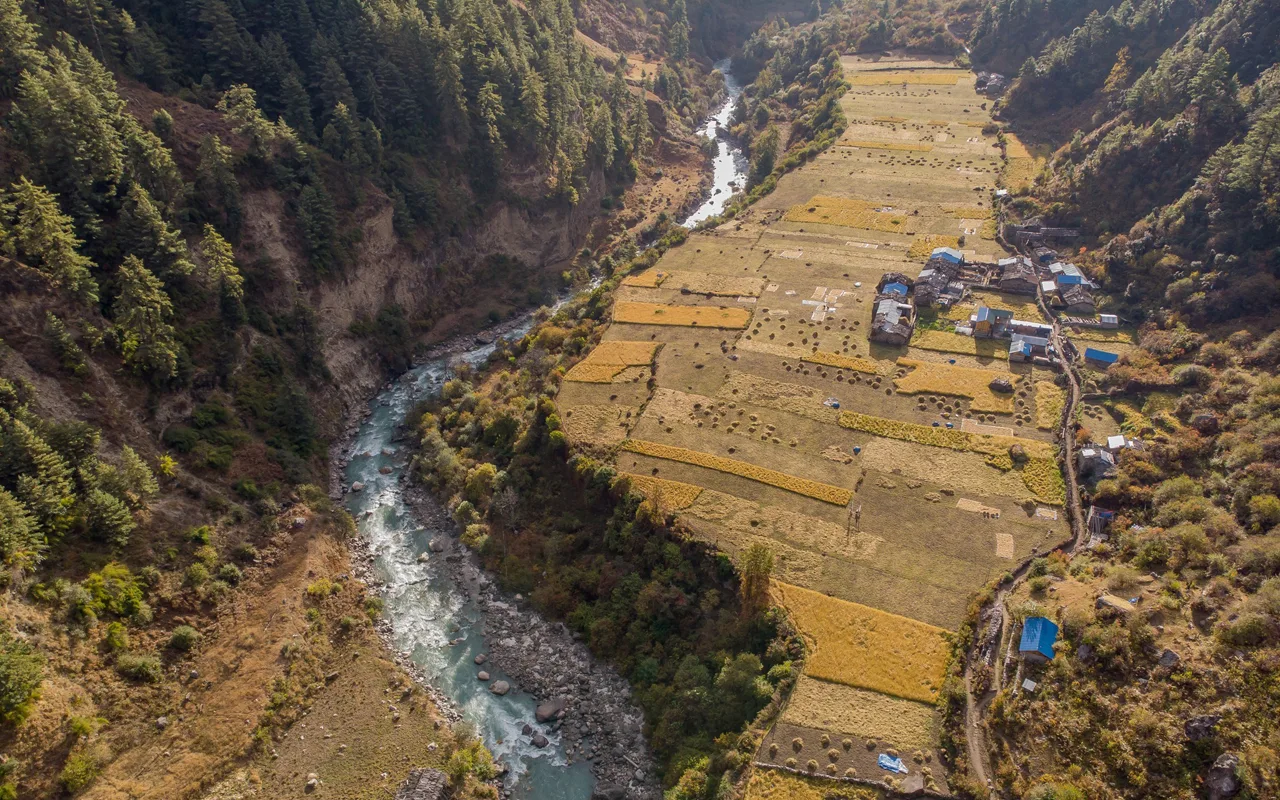
A long drive north to Syabrubesi, seven hours or so on a road that follows the Trishuli upstream and climbs into the hills, with Ganesh Himal in view for much of the second half. The road is rough in places and the journey is genuinely tiring, but it is also a good introduction to the middle hills - terraced farmland, river confluences and roadside towns that see very few visitors. Syabrubesi sits at 1,460m at the confluence of the Bhote Koshi and the Langtang Khola, and is the road head. Overnight in a lodge in the village.
Day 3 :
Syabrubesi to Lama Hotel
The walking starts. We cross the river and climb steadily up the Langtang Khola through dense forest - subtropical at first, then temperate oak, maple and rhododendron - with the river loud below the trail for most of the day. Langur monkeys are common along this stretch and red panda live in this forest, though seeing one is a matter of considerable luck. It is five to six hours to Lama Hotel at about 2,470m, which despite the name is a handful of lodges in a clearing. The valley is steep-sided and enclosed here, so there are no mountain views yet.
Day 4 :
Lama Hotel to Langtang village
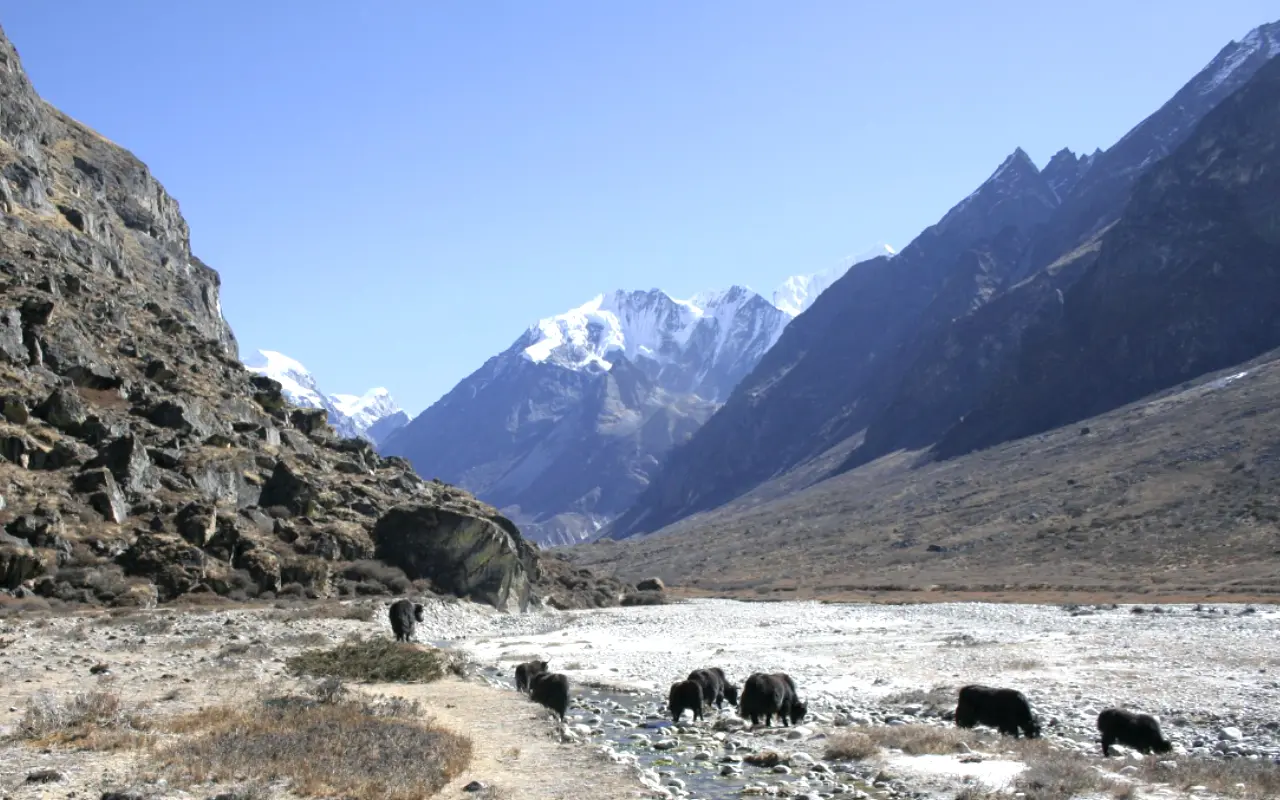
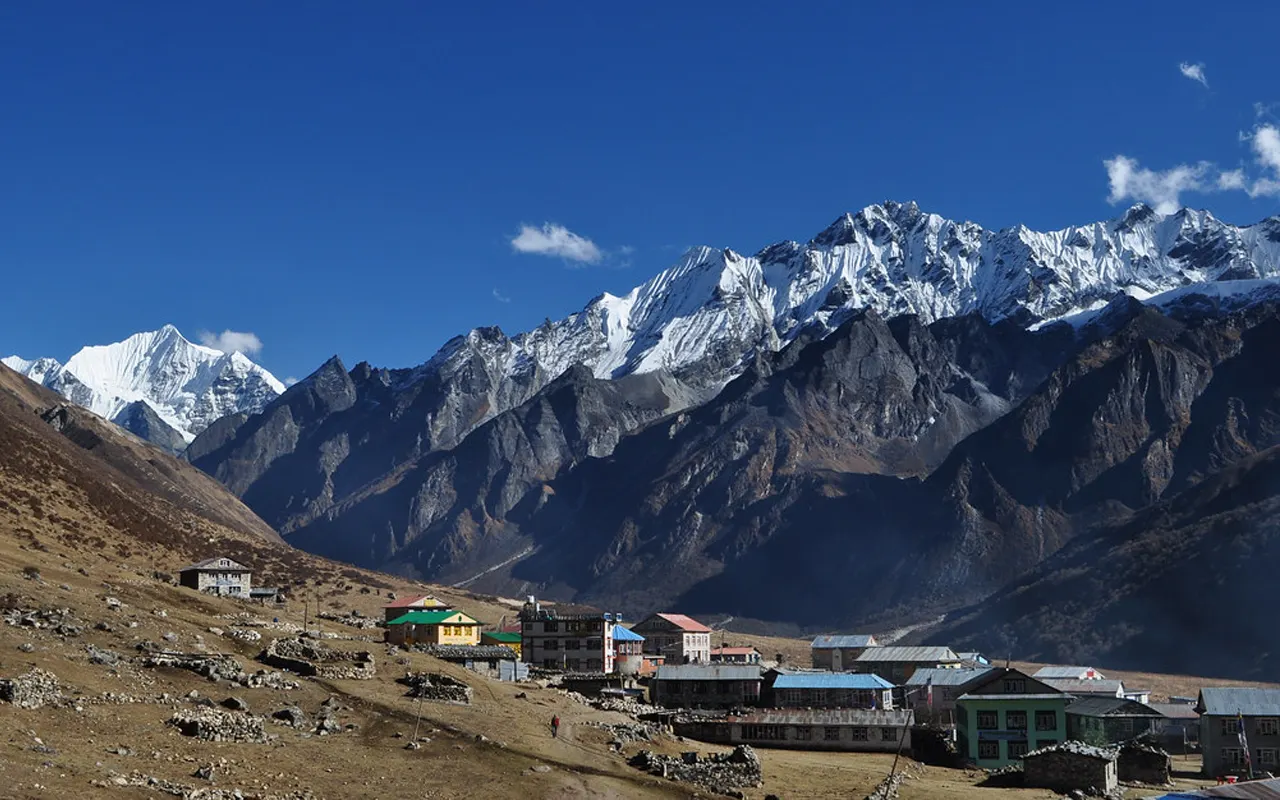
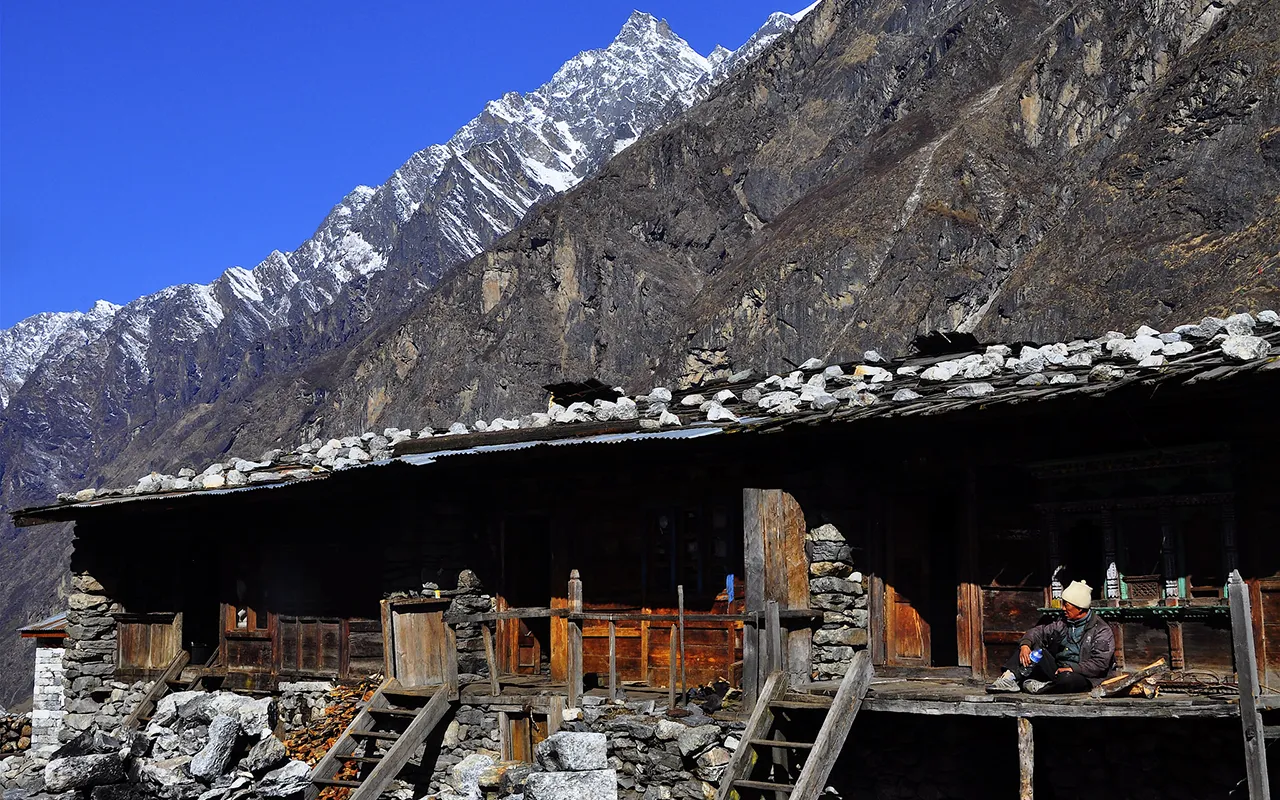
The trees thin as we climb and the valley opens out, and at Ghoda Tabela the first big peaks appear. Beyond it the valley becomes broad and glacial, with yak pastures, mani walls and water-driven prayer wheels along the trail. Langtang village at 3,430m was destroyed by a landslide triggered by the 2015 earthquake, which killed most of the population; it has been rebuilt on a slightly different site by the people who survived, and walking through it is a large part of why coming back to this valley matters. Five to six hours. Overnight in one of the new lodges.
Day 5 :
Langtang to Kyanjin Gompa
A short day, three to four hours, climbing gently past mani walls and yak pastures to Kyanjin Gompa at 3,870m at the head of the valley. The monastery is small and old, and there is a cheese factory beside it established with Swiss help in the 1950s that still makes yak cheese you can buy. The setting is the point: Langtang Lirung at 7,227m directly above, with glaciers hanging off it, and the valley running east towards the Tibetan border. Arriving early leaves the afternoon free to acclimatise with a short walk on the valley floor.
Day 6 :
Kyanjin Ri or Tserko Ri
A full day above the gompa, climbing one of the two viewpoints. Kyanjin Ri at 4,773m is the shorter option, two to three hours up, and gives the whole Langtang Lirung massif with the glacier below and the valley running away west. Tserko Ri at 4,984m is a longer and harder day - four to five hours of climbing - and opens out the view east towards Dorje Lakpa and the Tibetan border peaks. Both are steep and both feel hard at that altitude. We come back down to Kyanjin for a second night, which is good acclimatisation practice as well as being a fine place to spend an evening.
Day 7 :
Kyanjin Gompa to Lama Hotel
The long descent back down the valley, retracing the route through Langtang village and Ghoda Tabela to Lama Hotel - six hours or so, mostly downhill, and much faster going than the climb. The valley reads differently in this direction, with the peaks behind you and the forest closing in ahead. Appetite and sleep both improve markedly as you lose height. Overnight at Lama Hotel.
Day 8 :
Lama Hotel to Thulo Syabru
Rather than going straight back down we branch up to Thulo Syabru, a ridge village of stacked houses at about 2,250m with a gompa above it and views across to Ganesh Himal and back up the Langtang valley. It is a climb of a couple of hours after the descent from Lama Hotel, so a mixed day of five hours or so. Thulo Syabru is Tamang, and it is also the junction with the Gosaikunda trail - the chain of high lakes sacred to Shiva lies a day and a half above the village, and the itinerary extends that way if you have the time.
Day 9 :
Thulo Syabru to Syabrubesi
A short final morning of walking, dropping steeply from the ridge to the road head at Syabrubesi in three hours or so, through terraced farmland and past water mills. There is time in the afternoon to rest, wash and eat properly before the drive tomorrow. The last evening is usually spent with the crew, and it is customary to settle tips at this point rather than at the airport.
Day 10 :
Drive to Kathmandu
The drive back down the Trishuli road to Kathmandu, seven hours or so, arriving in the afternoon. The road is the same one you came up and is no more comfortable in this direction, but it is a good deal easier when you know it ends in a hot shower. You are transferred to your hotel, and there is a farewell dinner in the evening.
Cost
The Cost Includes
- 2 nights twin-sharing hotel accommodation in Kathmandu with breakfast
- Teahouse and lodge accommodation for 8 nights on the trail
- All meals on trek - 8 breakfasts, lunches and dinners, with tea or coffee
- Government-licensed trekking guide, and one porter between two trekkers
- Guide and porter wages, insurance, equipment, food and accommodation
- All trekking permits, TIMS card and national park or conservation area fees
- Ground transport to and from the trailhead
- Purified drinking water on trek, by filter or purification tablets
- Basic first-aid kit and a pulse oximeter carried by the guide
- Farewell dinner in Kathmandu
The Cost Excludes
- Domestic flights where the itinerary uses them, quoted separately
- Lunches and dinners in Kathmandu
- Hot showers, battery charging and Wi-Fi at teahouses
- Bottled or boiled water, and all other drinks
- Personal trekking equipment and clothing
- Extra nights in Kathmandu caused by an early return or a flight delay
- International flights to and from Nepal
- Nepal entry visa (USD 30 for 15 days, USD 50 for 30 days, USD 125 for 90 days, on arrival at Kathmandu airport)
- Travel and medical insurance, including emergency evacuation cover
- Personal expenses - laundry, phone calls, bar bills and shopping
- Tips for your guide and driver
- Anything not listed under "The Cost Includes"